Redundancy Doesn’t Mean Waste
Trends abound in the business world as in other parts of society. The notion that redundancy is waste is one such trend, promoted chiefly by business management schools and firms that propagate similar thinking. If redundancy is waste, then so is resiliency. If redundancy is waste, so is the capacity for a business to adapt to changing commercial circumstances. If redundancy is waste, so is agility, flexibility, and strength. Of course, none of these qualities are wasteful.
Though it carries different meanings in different contexts, redundancy has too often been misconstrued in the business realm, equated with unwanted and unneeded excess.
Redundancy is a fail-safe. It is a fallback. A contingency plan. Your car has four tyres, and you keep a fifth in the back for emergencies. If one fails, you have a replacement on hand. Fire exits, power backups, spare chargers and spare torches are redundant too.
Nature’s Example: Redundancy as a Survival Mechanism
In the natural world, redundancy is a powerful mechanism. As a physiological example, consider how our bodies build proteins, which are essential for life. Proteins are constructed of smaller chemicals called amino acids. Our bodies use tiny machines called enzymes to connect the amino acids. The enzymes read from our DNA, and so know which amino acid goes where.
It is a bit like Lego, the Danish construction toy. If a protein is the final toy (the assembled pirate ship, house or whatever is displayed on the Lego box), then the enzymes are our hands, and the amino acids are the individual Lego bricks. DNA is the instruction manual that comes with the Lego set.
Just as in Lego, you sometimes swap one brick out for another, and just as Lego sets include extra pieces of the same shapes and colours (to replace those that go missing), DNA often contains multiple ways of creating the same protein. Without redundancy in the genetic code, we wouldn’t be alive. We’d have never been born. The image below describes the process in a way that must omit its full sophistication.
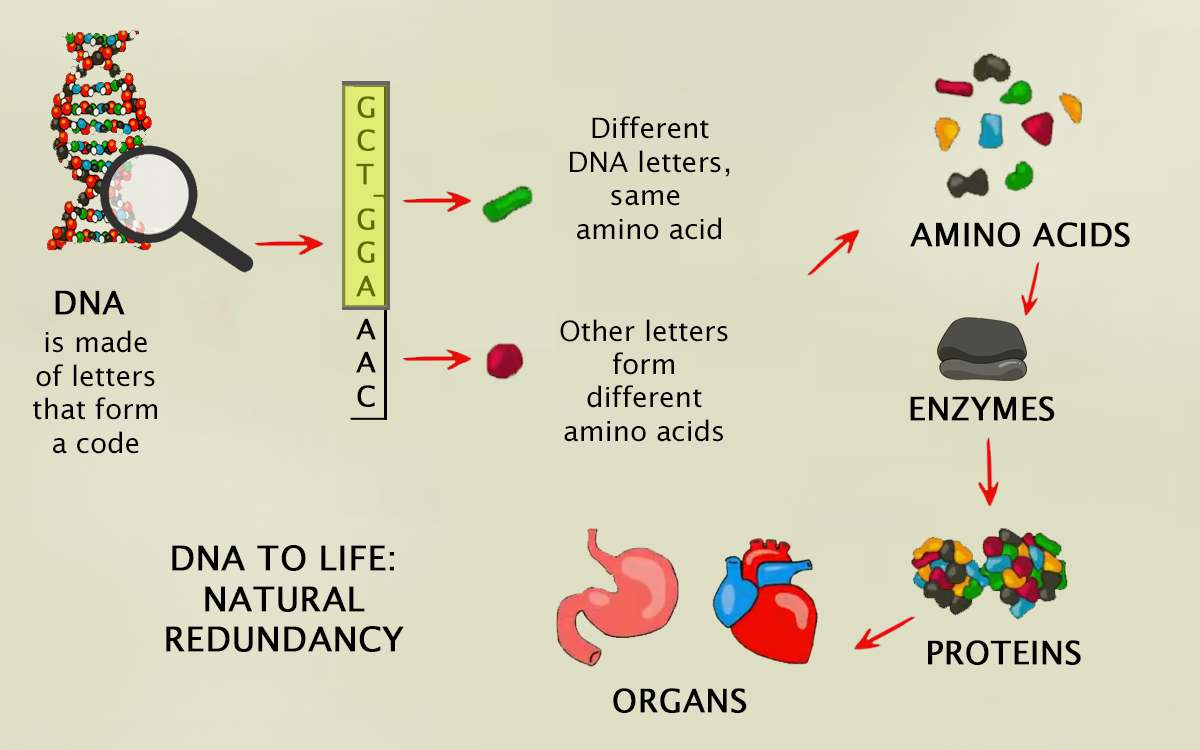
DNA is made of two strands of connected chemicals called nucleotides, represented by the letters A, C, G or T, which are abbreviations of the nucleotide names. Different three-letter sequences in DNA, called codons can produce the same or different outcomes (GCT and GGA both form the same amino acid, itself a building block for protein, while AAC forms a different amino acid). This is like redundancy in business, where multiple processes ensure resilience and flexibility.
For more information on genetic redundancy, check Wikipedia, the Khan Academy, a physiology textbook or any similar source.
The point is that redundancy occurs in the human body. It occurs in every living creature. It occurs throughout nature.
Like natural organisms that rely on redundancy, a business that does the same can recover from adversity. Having backup suppliers in case one fails is redundant. Redundancy lets companies recover from adversity. It reduces the risk of insolvency. Redundancy gives businesses with reserves. It protects them from harm and loss. It makes them more durable.
Eliminating Redundancy: Irrational and Illogical
The modern understanding of redundancy has turned the term into something malicious. Certain industrial psychologists, economists, and management consultants suggest eradicating redundancy. Any employee, group of employees, equipment, knowledge, resource, network, software, or tool that doesn’t seem immediately essential to the business’s survival is viewed as an unnecessary cost that should be expunged.
But what is ‘necessary’? A cost that doesn’t seem useful for a firm’s survival today might become fundamental tomorrow. Yet, those who follow this philosophy leave no room for redundancy.
Japan’s Greatest Industrialist: A Redundancy Proponent and Efficiency Movement Critic
Kōnosuke Matsushita, the founder of Panasonic, rejected this mechanistic view of commerce. His influence on Japanese manufacturing is immeasurable. Matsushita argued that businesses are inherently complex operations. The idea that the bosses should do the thinking and the workers merely wield the screwdrivers is foolhardy. Businesses exist in “an environment increasingly unpredictable”, according to Matsushita. The best way to respond is the “day-to-day mobilisation of every ounce of intelligence” from every employee, regardless of their position.
This philosophy, which values human input and adaptability over rigid efficiency models, shows that businesses need more than lean operations—they need redundancy to remain flexible and resilient. As Matsushita believed, making sacrifices for short-term gains is a dangerous path to follow.
Eliminating Redundancy: A Path to Self-Sabotage
Those who preach against redundancy want to make companies less obstinate and rigid. But the result they’re looking to avoid is the one they’ll bring to bear.
A company that ignores the strengths bestowed by redundancy, or that sees redundancy as a negative, is headed toward ossification. It is reducing its ability to compete. It is a form of self-sabotage.
When a company makes cutbacks, the remaining employees are forced to do more with less. Employee morale is reduced. So are the critical skills, familiarity and experience available to the company. Branches close. Customer service fails. Customer loyalty and satisfaction evaporate. Customers go elsewhere. The company itself is weakened. Departments crumble. The company becomes vulnerable to market shifts and increased workload demands. It damages its reputation, its revenue, its ability to stay competitive, its ability to grow and its ability to react. Again, this is the opposite of the intended effect but is the obvious outcome.
The adverse view of redundancy is astonishingly short-term. It is so reductionist that it seems remarkable anyone has given it earnest consideration, let alone applied it. Cutting a firm to pieces to increase revenue is untenable. The positives are so few and so brief, the negatives extensive and enduring.
How Trade Credit Insurance Shows Redundancy in Action
Those who mistakenly view redundancy as the unneeded are putting their businesses at risk. Cost-cutting strategists view that which is not immediately profitable as redundant. A management consultant might see trade credit insurance as an unnecessary cost. As redundant. Until, that is, a customer defaults. The business that has acted upon this erroneous counsel is at risk of insolvency, litigation costs and the painful, anxious process of retrieving lost income. Time and money must be spent on lawyers and debt collection. The business must use resources that could have been used to expand the firm. Trade credit insurance is designed to quickly redeem losses from bad debts and to minimise the harms associated with customer insolvencies. Far from being wasteful, it is a crucial defence against unforeseen business risks.
Redundancy is a Necessary Path to Commercial Success
Redundancy is essential to human nature. The universe grew because of redundancy and has survived for nearly 14 billion years. Every business that sees redundancy as a force for good is a business that will continue to survive. By allowing companies to achieve the maximum output possible and respond to the unforeseeable, redundancy makes businesses more robust, profitable, and less susceptible to risk.
